
Appearance
Haskoning Carbon Database
Welcome to the guide for the Haskoning carbon database. Here you can read through the why the Haskoning carbon database is developed and how to work with it.
Find the database Here!
Goal
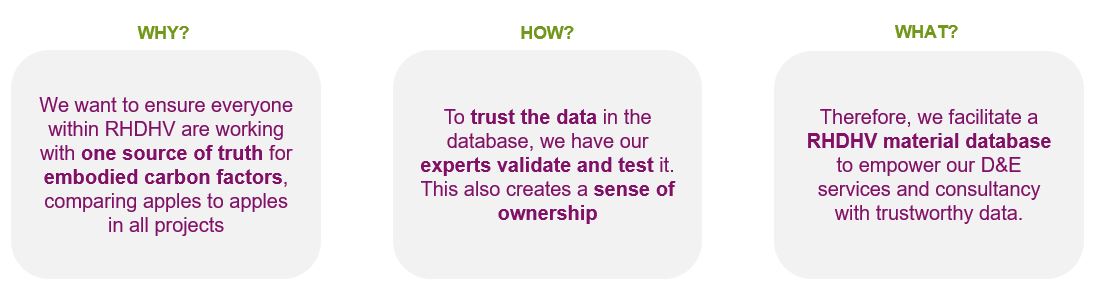
The goal is to develop a material database that is trusted by our experts i.e. sustainability consultants and technical designers/engineers (Architecture & Building Technology; Structure; Building Physics; Mechanical-Electrical-Plumbing) to ensure there is a ‘one source of truth’ for embodied carbon factors within Haskoning.
Vision
The larger vision is to leverage the data in this material database into our Design and Engineering or Consultancy services, by embedding it into the various tools or softwares we use for our day to day work, we can make informed decisions while consulting or designing or engineering new buildings or renovations for our clients.
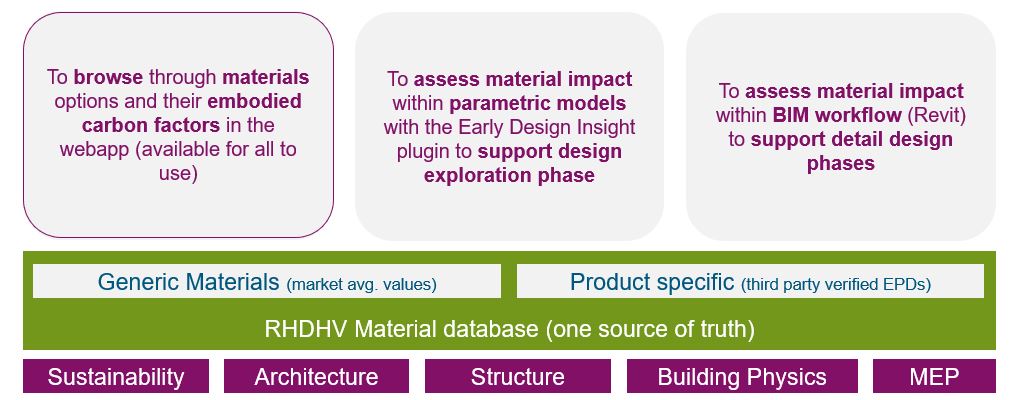
We see three possible use cases for the database,
- To browse and look for the embodied carbon factors of various materials or products using the webapp
- To assess material impact in a parametric workflow using the Early Deisgn Insights tool available as a plug-in for grasshopper in Rhino, to support early stage design exploration.
- To assess material impact in a BIM workflow to support in detail design stages to ensure the track the embodied carbon emissions through design development.
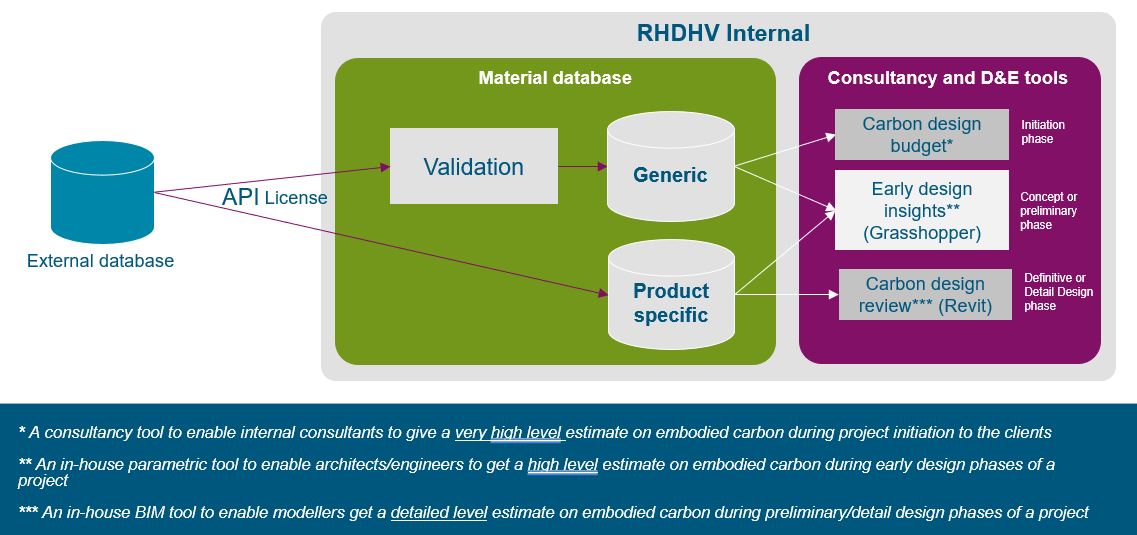
As gathering data and mantaining a database can be very laborious, we decided to partner up with an external material database supplier, for now its Materials2050,in case we find other valuable parties, then an expansion is always possible.
Materials2050 extracts and maintains material or products related sustainability data from various data sources, such as national databases or Evironmental Product Declarations (EPDs). You can read more about Materials2050 here https://2050-materials.com/.
Connecting the Haskoning carbon database to the Materials2050 API license gives us access to two kinds of databases Generic (~8000 datapoints) and Products (~128000 datapoints), more about these databases in following sections. With access to multiple materials or prdoucts and their sustainability data in one central Haskoning carbon database, it allows us to connect this data to various internal Consultancy and D&E tools.
What is in the Haskoning Carbon Database?
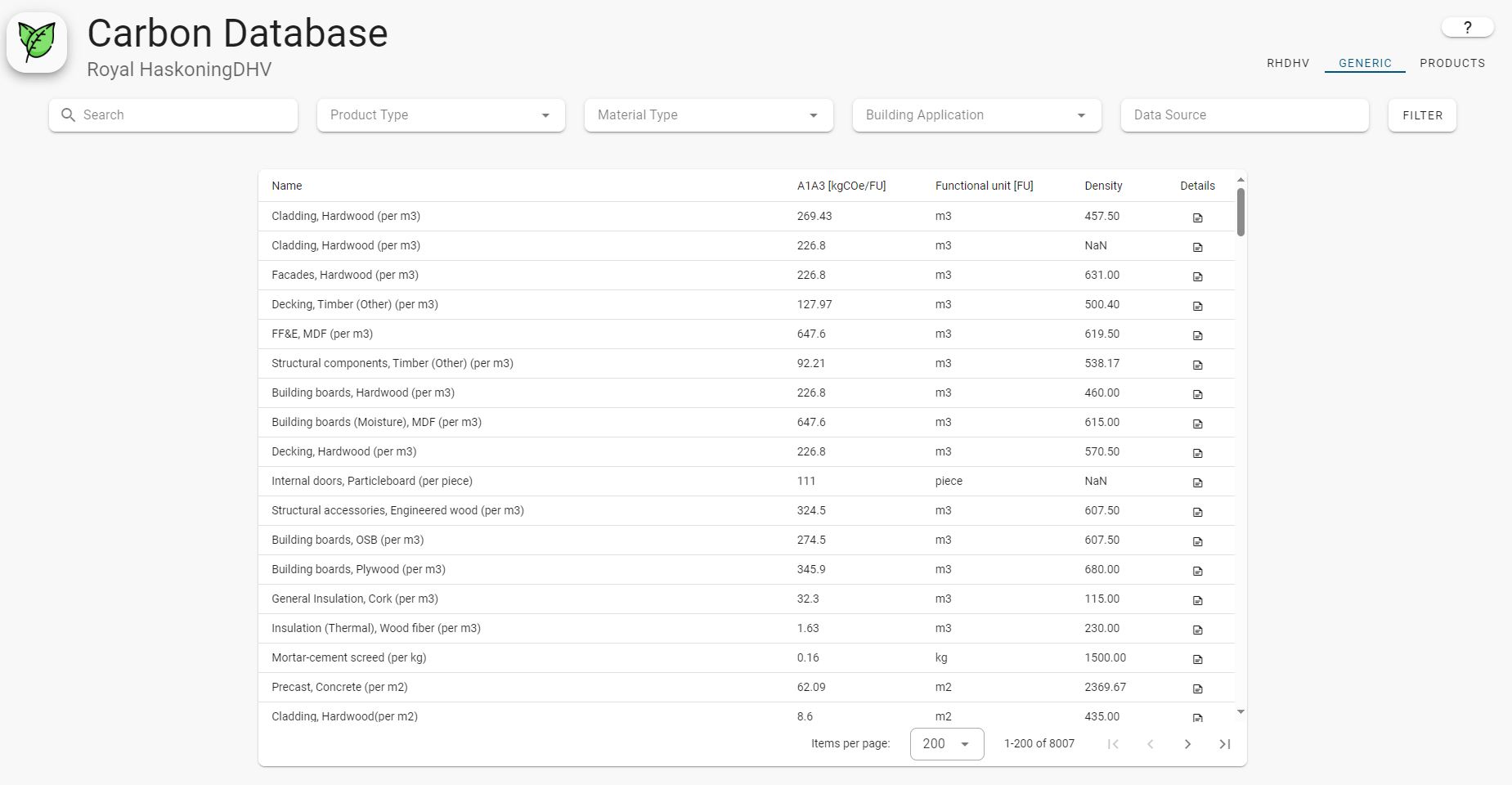
The Haskoning Carbon Database holds embodied carbon data of materials and products from various sources in three tabs, Haskoning; Generic and Products.
Haskoning
The data under this tab holds information from publicly available open datasets and data collected by knowledge groups throughout the company. Note: Please be aware that this is holds old and data that is not regularly updated. Therefore, these unit values could be expired.
The latest addition are Generic and Products tabs that leverages the Materials2050 database API license. These datapoints are updated and maintained by Materials2050.
Generic
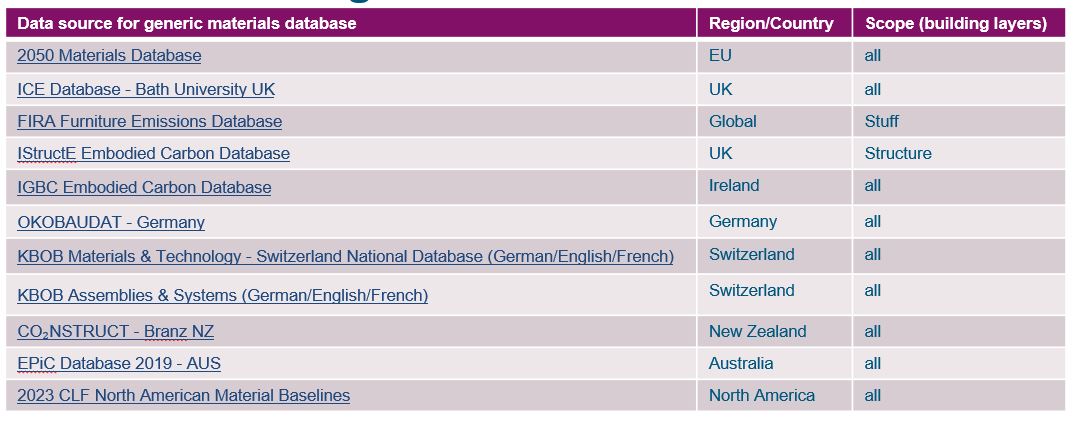
The data under this tab has embodied carbon data of generic building materials and products. These embodied carbon values are based on market averages or statistical averages over multiple EPDs of the same type of material or product. Data is sourced from Materials2050 generic database; some country specific national databases such as OKOBAUDAT-Germany, IGBC embodied carbon database-Ireland, KBOB Materials&Technologies -Switzerland, CO2NSTRUCT - New Zealand, etc; and embodied carbon databases from international organisations such as IStructE. See table below for all the various data sources that is covered by the generic database.
Products
The data under this tab has embodied carbon data sourced from manufacturers' Environmental Product Declarations (EPD), a third party verified certificate informing on envrionmental impact of manufactured materials or products.
Note: This tab is slow in loading data due to number of data points being loaded. It is an issue on the API side and is recognised by the development team. They are working on resolving this. Until then, we appreciate your patiance while working with it.
How to use it?
You can use the webapp available here, to search for materials and products that you need for your projects to gain insights on the environmental impact, specifically the cradle to gate impact (A1-A3 life cyle stages of a product or material). You can always find impact factors for other life cycle stages too, under details.
You can search for materials and products in either of the available tabs.
You can either search using keywords in the search bar or by selecting the suitable filter to narrow your search scope. After making the appropriate selections, do not forget to click on the filter button.